
This questionnaire
- Measures gender identity, gender roles, and sexual orientation in research.
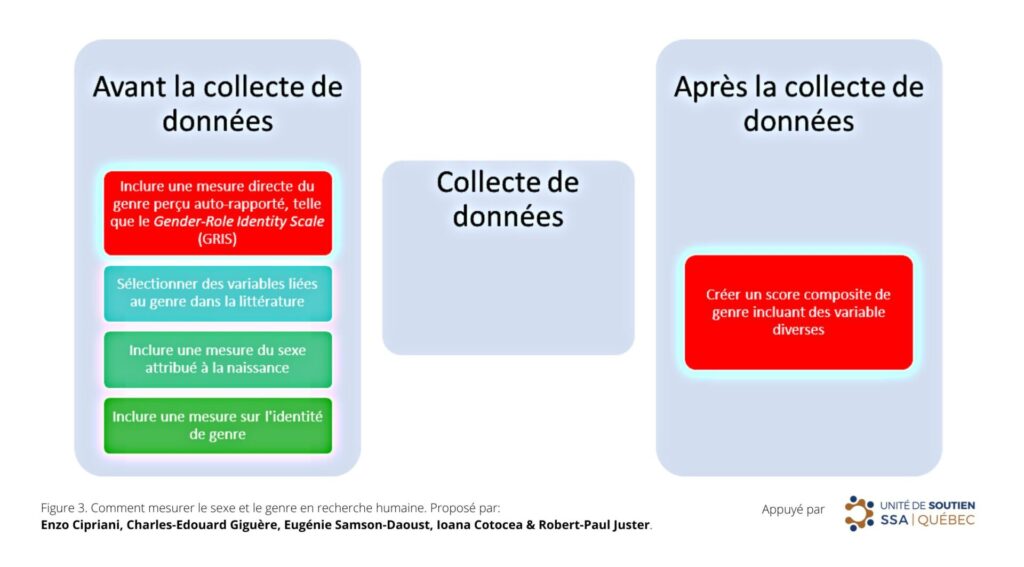
- Corresponds to a self-reported measure of perceived gender to be incorporated prior to data collection.
This questionnaire is a Gender Role Identity Scale (EIRG; GRIS).
The scientific literature and the general considerations of equity, diversity and inclusion addressed in the United Nations’ Sustainable Development Goals, Canada’s and Québec’s research funds are increasingly emphasizing the need to take sex and gender into account in research projects.
- Researcher or research professional
- Healthcare professional
- Social services professional
- Professor
- Student
- Family medicine clinic or family medicine group
This tool promotes the inclusion of sociocultural gender in health research, as well as other indicators such as sex assigned at birth and sexual orientation. This objective addresses two main challenges:
- The lack of consideration for gender in clinical practice, particularly due to a lack of relevant literature
- The lack of inclusion of gender in health research, which limits the scope of the results obtained
Questionnaire for Measuring Gender in Prospective Surveys
This tool is designed to measure these concepts in prospective surveys (collection of new data). Read the article A step-by-step and data-driven guide to index gender in psychiatry
Questionnaire to measure gender and sexual orientation in clinical settings
This tool can also be used in clinical settings to gain a better understanding of the gender and sexual orientation of the person receiving services. It allows for the provision of care appropriate to their situation or the identification of risk factors underlying their status, particularly regarding mental health, since 2SLGBTQ+ individuals are twice as likely to suffer from mental health disorders and experience suicidal ideation. Nevertheless, in this context, it is essential to pay particular attention to ethical considerations.
Developed in partnership with people of gender diversity
These tools were developed in part in partnership with people of gender diversity during a summer internship. During the course of this internship, particular work was done to discuss the life experiences of people from diverse backgrounds as well as to develop a theoretical understanding of gender identity and its role in the lives of individuals. This was in order to include the views and perspectives directly affected by these considerations and to gain a deeper understanding of the individual experience of these people. This internship allowed one of the individuals involved to continue her university studies as a result of the experience she gained.
First, the tool provides a definition of sex and gender, as well as an explanation of why it is important to measure these concepts in research, before introducing the tools.
4 axis
This document is therefore constructed in 4 main areas:
1) What is sex and gender?
A quick presentation of the rational behind the concepts of sex and gender.
2) Why measure gender in human research?
A short review of the literature to highlight the scientific support for this measure.
3) How to measure gender? A brief presentation of a questionnaire developed to measure the gender of individuals.
4) Some preliminary results supporting the quality and contribution of the tools presented.
Next, this is a questionnaire whose sections are described in detail, including the original sources and the rationale behind its design.
- Questions 1 through 4 measure sex and gender identity;
- Question 5 measures sexual orientation;
- Questions 6 through 11 measure gender roles, relationships, and gender identity.
The questionnaire is then presented in a ready-to-use format in French and English.
John is a social worker and would like to use a short questionnaire to gather some information before meeting with the patient.
Having had the opportunity to work with people from diverse sexual and gender backgrounds, he is aware that these individuals face specific challenges. John therefore decides to use the EIRG questionnaire.
Using the Guide
Since John does not intend to conduct research with this data, he decides to use only questions 1 through 5. The questions are simple and well-worded; he simply needs to include them in the preliminary questionnaire he sends to his clients while maintaining professional confidentiality.
Impact
John knows his clients’ identities in advance. He will therefore tailor his meetings to offer services better suited to this population, such as referrals to specialized organizations when necessary.
The questionnaire, supported by the Unité de soutien SSA Québec, was designed in 2022 by:
- Enzo Cipriani
- Charles-Edouard Giguère
- Eugénie Samson-Daoust
- Ioana Cotocea
- Robert-Paul Juster
Cipriani, E., Giguère, C. E., Samson-Daoust, E., Cotocea, I., & Juster, J. P. (2022). Mesurer le genre en recherche sur les humains, un nouveau questionnaire adapté. Canada, Montréal: Unité de Soutien SSA Québec.
Note that the questionnaire is presented in a ready-to-use format in French and English.
Creation guide for a Composite Sociocultural Gender Index

This document is part of a larger project that includes two tools for assessing the gender of people involved in health and other research projects (this gender measurement questionnaire and a guide for creating a composite gender index).
- See the creation guide for a composite genre index (in French)
- View key sex and gender questions
Creation guide for a Composite Sociocultural Gender Index
How can you measure the impact of sociocultural gender in your field of research? With this tool, your results will highlight the importance of considering gender and identify trends that differ significantly from those observed when measuring sex alone.